
Desktop Dual-Axis Belt Sander for Knife Sharpening and Polishing with 750W Motor and 1000-7000 RPM Variable Speed Control
Blue / 110V US
£243.98
Skip to product information

 The desktop dual-axis belt sander is engineered for the craftsman who demands precision and efficiency. With a robust 750W motor and a speed range of 1000 to 7000 rpm controlled by a variable switch, it handles everything from reshaping a chipped blade to putting a mirror finish on a metal project. Its two sanding heads mean you can mount a coarse and a fine grit belt simultaneously, turning a multi-step process into a fluid operation. The compact 310 x 250 x 190 mm steel frame provides a stable, space-saving foundation on any workbench, making it a versatile centrepiece for detailed workshop tasks.
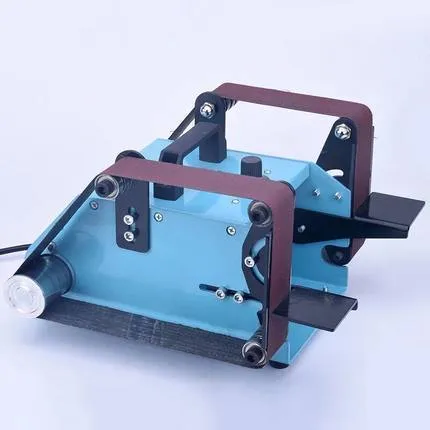 This section details the specific components and construction that contribute to the sander's performance, from its power system to its practical design for daily workshop use.


Desktop Dual-Axis Belt Sander for Knife Sharpening and Polishing with 750W Motor and 1000-7000 RPM Variable Speed Control
£243.98
Desktop Dual-Axis Belt Sander: A 750W Workshop Tool for Sharpening and Polishing
Features and Build Quality of the Belt Sander
Dual-Axis Sanding Head Design
The defining feature is the two independent sanding heads. Each accepts a standard 40 mm wide by 680 mm long abrasive belt. This configuration allows for a significant workflow advantage; you can progress from rough grinding on one head to fine finishing on the other without stopping to change belts. The heads are positioned to provide good access to the platen, the flat metal surface behind the belt, which is essential for achieving straight, consistent edges on tools and blades.Motor Power and Speed Specifications
At the core is a 750-watt motor designed for 220V operation. This power rating ensures the sander maintains its set speed under the pressure of grinding, preventing the slowdown that can lead to uneven results. The continuously variable transmission allows you to dial in the exact speed between 1000 and 7000 revolutions per minute. For instance, you might use 2000 rpm for shaping hardwood without scorching, and 5000 rpm for polishing a bevel to a sharp, clean apex.Frame Construction and Stability
Practical Applications in the Workshop From professional sharpening to hobbyist crafting, this tool's variable speed and dual-head design suit a wide array of tasks. Below are specific scenarios where it proves its utility.Professional Tool Maintenance
For carpenters, woodturners, or chefs maintaining their kit, this sander offers a dedicated station. The ability to keep a 120-grit belt on one head for reprofiling a damaged plane iron and a 400-grit belt on the other for honing means a tool can be restored from dull to sharp in minutes. The variable speed control is key here, allowing a slower pace for heat-sensitive tool steels to avoid losing their temper during grinding.Everyday Hobbyist and DIY Use
Versatility for Craft and Model MakingTangible Benefits and Long-Term Value Investing in a capable bench sander like this one translates to measurable improvements in your work quality and efficiency. Here’s how it delivers value over time.Cost and Time Efficiency Value
While the initial outlay is for the machine, the ongoing cost is in the widely available 40x680mm abrasive belts, which are relatively inexpensive. Compared to sending tools out for professional sharpening or using slower, manual methods, the time saved on each project quickly offsets the initial investment. For someone regularly maintaining a set of woodworking chisels or kitchen knives, the sander pays for itself by restoring tools to optimal condition in-house.User Experience and Result Satisfaction
Reasons to Choose This Workshop Sander</h3 If your work involves creating or maintaining edges, this sander provides a measurable upgrade. The dual-head capability effectively doubles your workspace, the 1000-7000 rpm range offers surgical control for different materials, and the 750W power ensures it handles the workload. It’s a tool designed to perform specific tasks reliably, turning tedious finishing jobs into quick, repeatable processes.